
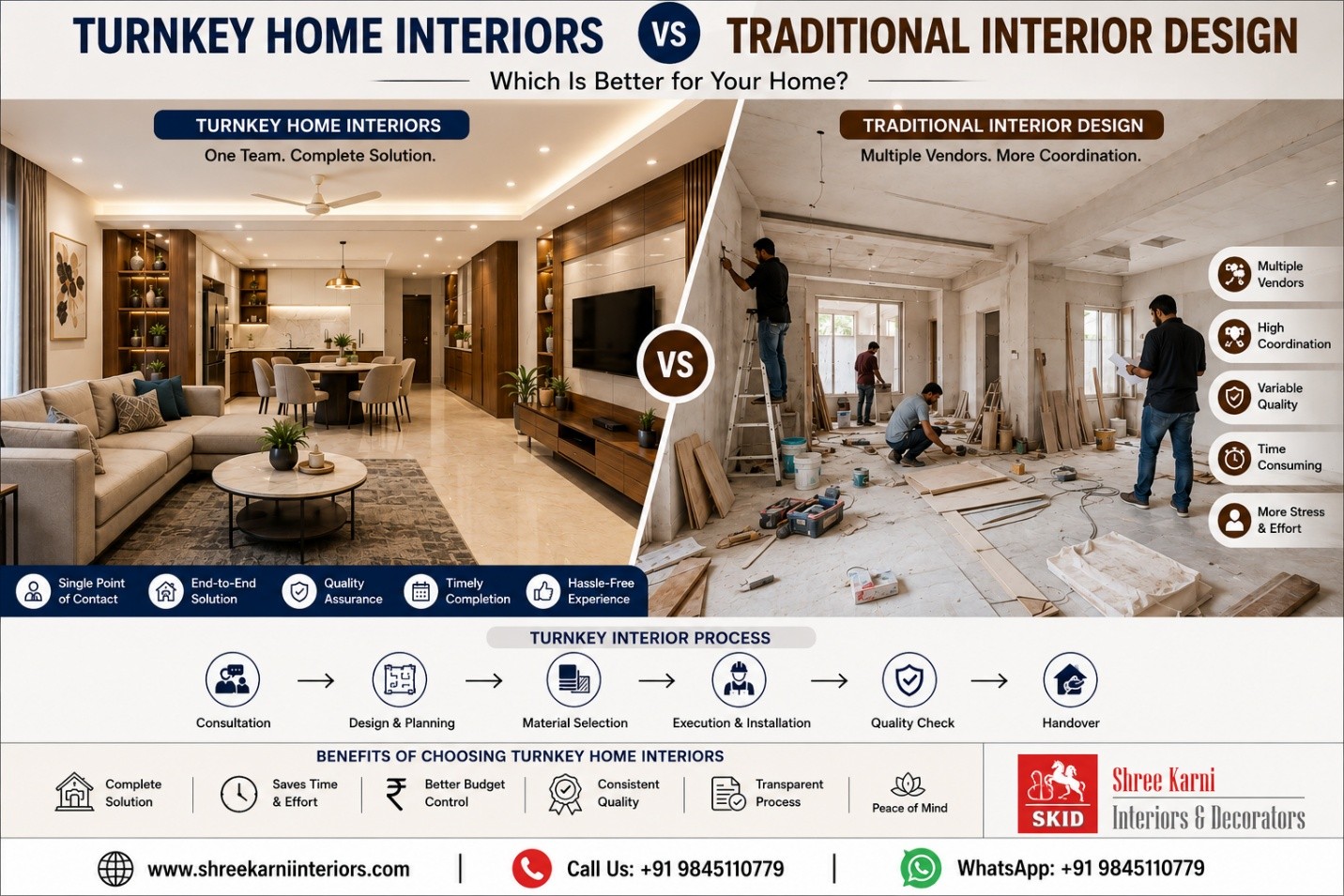
Choosing the right interior design approach can affect your home’s functionality, appearance, budget, timeline, and overall experience. Two common options are Turnkey Home Interiors and traditional interior design.
A turnkey approach brings design, material selection, execution, installation, and project management under one primary team. Traditional interior design may involve an interior designer working with separate carpenters, electricians, painters, suppliers, and contractors.
Both approaches can create attractive and functional spaces. However, they differ in how the work is planned, managed, executed, and coordinated.
The right choice depends on your budget, project size, customization requirements, available time, preferred level of involvement, and expectations from the interior company.
Understanding these differences can help you select an approach that matches your requirements before starting your home interior project.
What Are Turnkey Home Interiors?
Turnkey Home Interiors are complete design and execution services in which one interior company manages multiple stages of a residential project. Depending on the provider, the service can cover everything from initial consultation and space planning to design, material procurement, manufacturing, installation, finishing, and final handover.
Instead of coordinating several independent professionals, homeowners can work with one primary team responsible for managing the agreed scope.
Depending on the package, services may include:
Space planning
Interior design
3D visualization
Storage units
TV units
Custom furniture
False ceiling
Electrical work
Lighting
Painting
Flooring
Wall treatments
Hardware
Material procurement
Installation
Site supervision
Quality checks
The exact scope varies between providers. Before signing an agreement, review the quotation carefully and confirm the materials, services, labour, installation, taxes, warranties, exclusions, and payment terms.
How Do Turnkey Home Interiors Work?
The process usually starts with an initial consultation. The design team discusses your lifestyle, space requirements, storage needs, preferred style, functional priorities, and budget.
The next stage involves developing layouts and design concepts. Depending on the project, this may include floor plans, furniture layouts, color schemes, material selections, elevations, and 3D visualizations.
Once the design is approved, materials, finishes, hardware, and specifications are finalized. The execution team then coordinates procurement, manufacturing, site preparation, installation, electrical work, painting, and finishing.
Quality checks are carried out before the final handover.
This centralized process can reduce the amount of coordination required from the homeowner while providing a clearer workflow from design to completion.
What Is Included in Turnkey Interior Design Services?
The scope of Turnkey Interior Design Services varies between providers. Some companies offer complete design and execution, while others may exclude civil work, plumbing, major electrical modifications, appliances, or loose furniture.
A comprehensive package may include:
Modular kitchens
Bedroom wardrobes
Storage solutions
Living room furniture
Study units
False ceilings
Lighting
Electrical modifications
Painting
Flooring
Wall panels
Hardware
Installation
Site supervision
Always request a detailed scope of work before making a decision. This allows you to understand what is included and compare quotations more accurately.
What Is Traditional Interior Design?
Traditional interior design generally involves working with an interior designer, contractor, or several independent specialists.
For example, a homeowner may hire a designer for planning, a carpenter for furniture, an electrician for electrical work, a painter for wall finishes, and separate suppliers for lighting, flooring, and furnishings.
This model gives homeowners greater direct control over individual vendors and purchases.
It can be suitable for people who already have trusted contractors or prefer to supervise different stages of the work themselves.
Advantages of Traditional Interior Design
Traditional interior design provides flexibility and greater involvement in individual decisions.
Some advantages include:
Direct control over contractors
Freedom to compare vendors
Flexibility to purchase materials independently
Direct negotiation with suppliers
Ability to choose specialized professionals
Option to complete work in phases
Greater involvement in execution
For homeowners who enjoy managing different aspects of a renovation, this approach can provide considerable control.
Challenges of Traditional Interior Design
The main challenge is coordination.
When several contractors are involved, their schedules and responsibilities need to be managed carefully. A delay in one activity can affect the next stage.
For example, electrical work may need to be completed before certain carpentry or ceiling work begins. If one contractor is delayed, other workers may also have to wait.
The homeowner may need to manage:
Multiple quotations
Payment schedules
Material purchases
Contractor communication
Site visits
Work schedules
Quality checks
Material deliveries
Unexpected expenses
For homeowners with demanding schedules, managing these responsibilities can become time-consuming.
Turnkey Home Interiors vs. Traditional Interior Design: Key Differences
The biggest difference between the two approaches is how the work is organized and managed.
Factor | Turnkey Home Interiors | Traditional Interior Design |
Project management | One primary interior team | Multiple contractors or vendors |
Design and execution | Usually integrated | May be handled separately |
Communication | One main point of contact | Multiple points of contact |
Vendor coordination | Managed by the interior company | Often handled by the homeowner |
Budget monitoring | More centralized | Requires closer tracking |
Material coordination | Managed by the project team | May involve several suppliers |
Scheduling | Centrally coordinated | Depends on individual contractors |
Quality control | Coordinated across the agreed scope | Varies between vendors |
Customization | High | High |
Homeowner involvement | Usually lower | Usually higher |
Convenience | High | Depends on homeowner involvement |
Accountability | More centralized | Shared across vendors |
Neither approach is automatically better for every homeowner.
A turnkey model generally focuses on convenience, centralized management, and coordinated execution. Traditional interior design provides greater flexibility and direct control over individual contractors and purchases.
Your decision should depend on your budget, project complexity, available time, preferred level of control, and the scope of work required.
Turnkey Interior Design Cost vs. Traditional Interior Design Cost
One of the most important factors to consider is Turnkey Interior Design Cost.
There is no fixed price for every project. The final budget depends on the size of the property, number of rooms, materials, finishes, furniture, labour, customization, electrical requirements, and overall scope.
A complete home with a modular kitchen, wardrobes, false ceiling, lighting, electrical modifications, and custom furniture will have different requirements from a smaller project involving only selected rooms.
What Factors Affect Turnkey Interior Design Cost?
Several factors can influence the overall budget.
Home size: Larger homes generally require more materials, furniture, labour, and installation.
Number of rooms: Additional rooms can increase the need for furniture, storage, lighting, painting, and finishing.
Material selection: Boards, laminates, veneers, glass, hardware, and finishes are available at different price points.
Kitchen requirements: Kitchen size, storage configuration, hardware, accessories, finishes, and appliance integration can influence the budget.
Wardrobes and storage: The number and size of units, internal layouts, finishes, and hardware affect pricing.
Electrical and lighting: Additional electrical points, switches, fixtures, and decorative lighting may increase the overall expense.
False ceiling: Design complexity, materials, lighting integration, and installation requirements influence the budget.
Customization: Special furniture, unique storage systems, premium finishes, and customized layouts may require additional investment.
How Should You Compare Interior Design Costs?
Comparing only the final price of two quotations can be misleading.
A more useful comparison considers:
Design + Materials + Labour + Transportation + Installation + Project Management + Finishing
For example, one quotation may include hardware and installation, while another may list them as additional charges.
Ask each provider to prepare a quotation based on the same scope of work and material specifications. This makes it easier to compare the actual value of each proposal.
What Should a Turnkey Interior Quotation Include?
A detailed quotation should clearly mention:
Design services
Scope of work
Material specifications
Product brands, where applicable
Labour
Installation
Transportation
Hardware
Taxes
Warranty
Payment schedule
Estimated timeline
Exclusions
Additional work charges
Understanding these details before starting can help prevent confusion about the final budget.
Planning Your Home Interior Budget?
Get a customized interior estimate based on your home, design requirements, materials, and budget.
Benefits of Turnkey Interior Design Services
Turnkey Interior Design Services bring multiple activities under one project team, making the overall process easier to coordinate.
One Point of Contact
Having one primary contact can simplify communication.
Instead of separately following up with a carpenter, electrician, painter, supplier, and installer, you can communicate your requirements to the project team.
This can reduce communication gaps and make project updates easier to monitor.
Better Coordination Between Design and Execution
Interior elements often depend on one another.
For example, the kitchen layout affects appliance positions and electrical points. Wardrobe dimensions need to suit the available space, while lighting should complement the ceiling and furniture arrangement.
When planning and execution are handled together, these requirements can be considered from the beginning.
Less Day-to-Day Supervision
Managing several contractors can involve frequent calls, site visits, and follow-ups.
A turnkey provider can coordinate many of these activities on your behalf. You still make important decisions about designs and materials, but you may not need to manage every individual worker.
Centralized Scheduling
A home interior project can involve design approvals, procurement, manufacturing, site preparation, installation, and finishing.
A centralized team can coordinate these activities according to an overall schedule and communicate potential delays or changes as the work progresses.
Easier Budget Monitoring
A detailed quotation provides a clearer view of planned expenditure.
If you decide to upgrade a material or add another requirement, the change can be discussed with the team before execution so that you understand its impact on the overall budget.
Consistent Execution
When one company coordinates multiple stages, design decisions and material specifications can be followed more consistently throughout the home.
Homeowners should still review materials, workmanship, and completed work before accepting the final handover.
When Should You Choose Turnkey Home Interior Services?
Turnkey Home Interior Services can be suitable when convenience and centralized project management are important to you.
You Have a Busy Schedule
If you have limited time, coordinating several contractors can be difficult.
A dedicated project team can manage much of the day-to-day coordination, allowing you to focus on major design and material decisions.
You Want One Team to Manage the Work
If you prefer one company to handle design and execution, this model provides a simpler communication structure.
You have one primary team to approach for project-related requirements.
You Need Multiple Interior Services
A coordinated solution can be useful when your home requires a modular kitchen, wardrobes, furniture, lighting, false ceiling, painting, electrical work, and other services.
Combining these requirements under one team can simplify execution.
You Want a Structured Process
A professionally managed project generally follows defined stages from consultation and design to execution and handover.
This gives you a clearer understanding of what happens at each stage.
You Prefer Convenience Over Vendor Management
If you would rather focus on design decisions than coordinate contractors and suppliers, a centralized service can be a practical choice.
When Is Traditional Interior Design a Better Choice?
Traditional interior design can be suitable for homeowners who want greater control over individual aspects of the work.
You Already Have Trusted Contractors
If you have reliable carpenters, electricians, painters, or other professionals, managing them directly may be convenient.
You Want Complete Control Over Purchases
Some homeowners prefer selecting and purchasing materials themselves.
Traditional execution can provide greater flexibility for this approach.
You Want to Negotiate Individual Services
Working with separate vendors allows you to compare quotations and negotiate the cost of individual services.
You Have Time to Supervise the Work
Traditional execution requires greater involvement. If you have time for site visits, contractor discussions, material selection, and quality checks, this model may suit you.
You Want to Complete the Work in Phases
If you want to complete the kitchen first and other areas later, working with separate contractors may provide greater flexibility.
Choosing Turnkey Interior Designers in Bangalore
If you are searching for Turnkey Interior Designers in Bangalore, do not select a company based only on the lowest quotation.
Consider its completed projects, design capabilities, material quality, execution process, project management, timelines, warranty, and after-sales support.
A professional interior company should be able to explain the complete scope of work and show how the project will progress from design approval to final handover.
Villa Interior Designers in Sarjapur Road
Homeowners searching for Villa interior designers in Sarjapur Road may have requirements that differ from standard apartment interiors.
Villas can involve larger floor areas, multiple levels, spacious kitchens, customized furniture, extensive storage, staircase areas, lighting plans, and other specialized requirements.
For these projects, centralized management can help coordinate different work areas and maintain consistency throughout the property.
Before hiring a provider, review its experience with similar residential projects and ask to see completed work.
Modular Kitchen Interior Indiranagar
Homeowners searching for Modular kitchen interior Indiranagar often want a kitchen that combines efficient storage with a design that complements the rest of the home.
A well-planned modular kitchen should consider available space, cooking habits, storage requirements, appliance placement, work zones, lighting, hardware, finishes, and maintenance.
Discuss these requirements with the design team before finalizing the layout. A coordinated approach can also help align the kitchen with electrical, plumbing, lighting, and other requirements.
How to Choose the Right Turnkey Interior Company
Selecting the right provider is important when investing in Turnkey Interior Solutions.
Review Previous Projects
Do not judge a company only by attractive design images. Review completed projects to understand its actual execution quality.
Pay attention to:
Finishing quality
Space utilization
Storage planning
Material selection
Hardware
Furniture detailing
Installation quality
Compare Detailed Quotations
Do not compare providers only on the final price.
Check whether each quotation covers the same materials, services, labour, installation, taxes, and other requirements.
A detailed comparison can reveal differences that may not be obvious from the total amount.
Check Material Specifications
Ask about boards, laminates, veneers, hardware, glass, electrical products, and other materials being proposed.
A detailed specification is more useful than a general statement such as “premium quality.”
Understand the Project Timeline
Ask for an estimated completion period and understand what factors could affect the schedule.
Design changes, material availability, site conditions, manufacturing requirements, and additional work can influence the timeline.
Check Warranty and After-Sales Support
Ask what happens if a product develops a defect or a workmanship issue occurs after handover.
Request warranty details in writing and understand how service requests are handled.
Read Customer Reviews
Reviews can provide useful insights into communication, workmanship, project management, timelines, and after-sales service.
Look at multiple reviews rather than relying on a single testimonial.
Understand the Contract
Before making a payment, read the agreement carefully.
It should clearly explain:
Scope of work
Materials
Payment terms
Project timeline
Design approvals
Changes and additions
Warranty
Cancellation conditions
Handover
Additional charges
A clear agreement helps reduce misunderstandings during execution.
Looking for Turnkey Interior Solutions in Bangalore?
Discuss your home interior requirements with Shree Karni Interiors and get a customized estimate for your project.
Enquire About Your Home Interiors
Questions to Ask Before Hiring a Turnkey Interior Company
Before selecting a provider, ask these questions.
What Is Included in the Package?
Confirm whether the package covers the kitchen, wardrobes, furniture, lighting, electrical work, false ceiling, painting, installation, and other requirements.
Which Materials and Brands Will Be Used?
Ask for detailed specifications instead of relying on general descriptions such as “premium quality.”
How Long Will the Work Take?
Ask for an estimated completion date and, where possible, a stage-wise schedule.
Who Will Manage the Work?
Find out who your primary contact will be and how progress updates will be shared.
What Happens If There Is a Delay?
Understand how delays caused by material availability, design changes, site conditions, or other factors will be handled.
Are Design Changes Included?
Ask how many revisions are included and whether changes after approval will result in additional charges.
What Warranty Is Provided?
Request written warranty details for materials, hardware, products, and workmanship.
Are There Any Additional Costs?
Confirm whether transportation, installation, taxes, hardware, electrical modifications, civil work, or other services are included or charged separately.
Turnkey Home Interiors or Traditional Interior Design: Which Should You Choose?
The right option depends on how much control and involvement you want throughout the process.
Choose Turnkey Home Interiors if you want:
One primary project team
Less contractor coordination
Integrated design and execution
Centralized management
A structured workflow
Greater convenience
A complete interior solution
Traditional interior design may be more suitable if you want:
Greater control over individual contractors
Independent material purchasing
Separate vendor negotiations
Direct supervision
Phased execution
More involvement in daily decisions
If convenience, coordination, and a single point of contact are important to you, a turnkey approach can make the process easier to manage.
If you prefer selecting every vendor and overseeing individual services yourself, traditional interior design may give you the control you want.
Before making a final decision, compare the complete scope of work, material specifications, workmanship, timeline, warranty, payment terms, exclusions, and total cost.
Ready to Plan Your Home Interiors?
Planning your home interiors requires more than choosing an attractive design. A successful project should balance functionality, aesthetics, materials, budget, workmanship, project management, and after-sales support.
If you are looking for a coordinated approach to designing and executing your home, discuss your requirements with an experienced interior design team.
Ready to Transform Your Home?
Plan your interiors with a coordinated team for design, execution, and project management.