
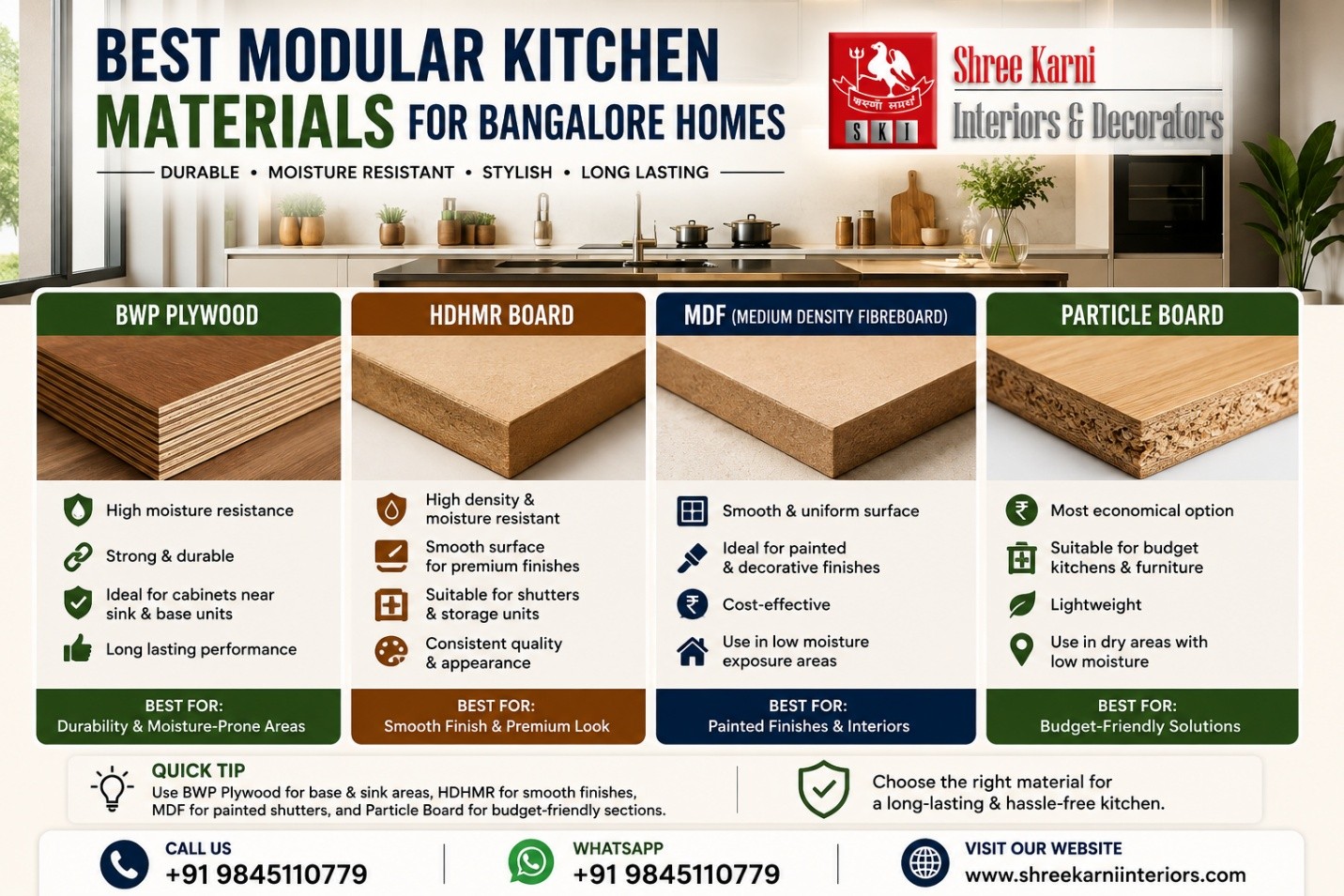
Choosing the right material is one of the most important decisions when planning a modular kitchen. The material used for cabinets affects durability, moisture resistance, maintenance, appearance, and overall cost. Bangalore homes can have different kitchen requirements depending on the layout, usage, ventilation, and exposure to moisture. This guide explains the major modular kitchen materials, including BWP plywood, HDHMR, MDF, and particle board. It compares their strengths, limitations, finishes, applications, and suitability for different kitchen areas. Understanding these options can help homeowners choose the best material for modular kitchen requirements based on durability, moisture exposure, maintenance, finish, and budget.
Planning your modular kitchen in Bangalore? Fill Out Our Enquiry Form to share your requirements with our team and get guidance on choosing the right materials for your kitchen.
What Are the Best Materials for a Modular Kitchen?
There is no single material that is ideal for every kitchen. The right option depends on where the cabinet is installed, how frequently the kitchen is used, the level of moisture exposure, the desired finish, and the available budget.
The commonly used materials include BWP plywood, HDHMR, MDF, and particle board.
BWP Plywood
BWP plywood, also known as Boiling Water Proof plywood, is designed to provide strong moisture resistance. It is made by bonding multiple layers of wood veneers under pressure, creating a durable and stable board.
BWP plywood is particularly suitable for areas that may experience occasional moisture, such as cabinets near the sink. Its strength also makes it suitable for base cabinets, wall cabinets, and other storage units that require good load-bearing capacity.
For homeowners looking for durability and moisture resistance, BWP plywood is a strong option for kitchen cabinetry.
HDHMR Board
HDHMR stands for High-Density High Moisture Resistance board. It is an engineered wood product manufactured under high pressure and temperature to create a dense and moisture-resistant board.
HDHMR provides a smooth surface that works well with several decorative finishes. It can be used for cabinet shutters, storage units, and selected kitchen applications where a smooth finish and consistent appearance are important.
MDF
MDF, or Medium-Density Fibreboard, is manufactured from fine wood fibres compressed with resin under high pressure and temperature. It has a smooth and uniform surface, making it suitable for painted and decorative applications.
However, standard MDF is less suitable for areas with frequent moisture exposure. It should therefore be selected carefully for kitchen applications and used where moisture exposure is controlled.
Particle Board
Particle board is made from compressed wood particles bonded with resin. It is generally a more economical option and is commonly used in budget-oriented furniture and kitchen applications.
While it can help reduce the overall cost of a kitchen, it does not offer the same level of strength and moisture resistance as BWP plywood. Its suitability depends on cabinet location, usage, construction quality, and moisture conditions.
BWP Plywood vs HDHMR for Modular Kitchens
When comparing BWP plywood vs HDHMR for modular kitchen requirements, both materials have useful characteristics, but their performance and applications can differ. The right choice depends on the cabinet location, expected usage, moisture exposure, finish, and budget.
BWP Plywood for Modular Kitchens
BWP plywood for modular kitchen cabinets is a practical choice when strength, durability, and moisture resistance are important. It can be used in areas where cabinets may be exposed to humidity or occasional water contact.
It is particularly useful for base cabinets and sink-area storage because these sections generally have a higher possibility of moisture exposure.
HDHMR for Modular Kitchens
HDHMR for modular kitchen applications can be considered where a dense, smooth engineered board is preferred. Its uniform structure provides a consistent surface for several decorative finishes.
It can be used for cabinet shutters and selected storage units, especially when the design requires a smooth surface for finishing.
BWP Plywood vs HDHMR: Key Differences
Feature | BWP Plywood | HDHMR |
Strength | High | High |
Moisture Resistance | Very good | Good |
Surface | Multiple wood veneer layers | Dense, smooth engineered surface |
Weight | Relatively lighter | Relatively denser |
Finishing | Suitable for laminates and veneers | Suitable for various decorative finishes |
Kitchen Use | Base, wall, sink, and storage cabinets | Shutters and selected cabinet applications |
Budget | Generally higher | Varies based on quality and specification |
How to Choose the Best Material for a Modular Kitchen
Selecting the right material requires more than comparing prices. Consider the location of each cabinet, expected usage, moisture exposure, maintenance needs, finish, and long-term performance before making a decision.
Moisture Resistance
Moisture resistance is especially important for cabinets near the sink and other areas where water may come into contact with the furniture.
Materials with better moisture resistance can help reduce the risk of swelling and deterioration when properly manufactured, sealed, installed, and maintained.
Durability and Strength
Kitchen cabinets are opened and closed frequently and may carry cookware, appliances, groceries, and other items. A strong material can provide better support and long-term performance.
Base cabinets generally require greater structural strength because they carry heavier loads.
Kitchen Usage
A kitchen used several times a day may require more durable materials than a kitchen with lighter usage. Consider cooking frequency, storage requirements, appliance placement, and daily activity before choosing the board.
Maintenance Requirements
Different surfaces require different levels of care. Smooth and properly finished surfaces are generally easier to clean, while damaged or poorly sealed surfaces may require more attention.
Regular cleaning and preventing prolonged water exposure can also help maintain kitchen cabinets.
Budget and Overall Cost
The material is only one part of the total modular kitchen cost. Hardware, finishes, accessories, countertop selection, design complexity, and installation also influence the final price.
Instead of choosing the least expensive board, compare durability, application, maintenance, and expected lifespan before making a decision.
Best Plywood for Modular Kitchen Cabinets
Plywood is widely used in kitchen cabinetry because it combines strength with versatility. However, different plywood grades are designed for different applications.
For homeowners searching for the best plywood for a modular kitchen, BWP plywood can be a practical option where durability and moisture resistance are important.
BWP Plywood
BWP plywood is a strong choice when moisture resistance is important. It can be used for kitchen cabinets that require better protection against humidity and occasional water exposure.
For many homeowners, it is a practical option when durability is a priority.
MR Plywood
MR plywood means Moisture Resistant plywood. It is designed to withstand normal indoor humidity but does not provide the same water resistance as BWP plywood.
It may be suitable for areas with lower moisture exposure, depending on cabinet location and construction.
Marine Plywood
Marine plywood is manufactured for demanding moisture-related applications and is generally associated with high-quality construction. However, the term “marine” should not automatically be treated as meaning better for every kitchen application.
The appropriate plywood should be selected based on the actual cabinet location, moisture exposure, quality, and project requirements.
Which Plywood Is Suitable for Different Kitchen Areas?
Plywood for kitchen cabinets should be selected according to the location and purpose of each cabinet. Base cabinets and sink cabinets generally benefit from materials with strong moisture resistance and structural strength.
Wall cabinets may have different requirements because they are less exposed to direct water contact. The final selection should consider cabinet location, expected load, ventilation, and construction method.
Best Modular Kitchen Materials for Different Areas
Different parts of a kitchen experience different levels of load and moisture. Using the same material everywhere is not always necessary.
Material for Base Cabinets
Base cabinets carry countertops, cookware, appliances, and stored items. A strong and durable material such as BWP plywood can be considered where higher strength and moisture resistance are required.
Material for Wall Cabinets
Wall cabinets generally carry lighter loads than base cabinets. The material can be selected according to the required strength, finish, design, and budget.
Material for Sink Cabinets
Sink cabinets are more likely to encounter water and humidity. Moisture-resistant materials are therefore important in this area.
BWP plywood can be a suitable choice when moisture exposure is a major concern.
Material for Tall Units and Pantry
Tall units and pantry cabinets may store groceries, appliances, and other household items. The material should provide sufficient strength for the intended load while matching the overall kitchen design.
Material for Overhead Cabinets
Overhead cabinets are generally used for lighter storage. The material can be selected according to the required load capacity, finish, design, and overall kitchen budget.
Popular Modular Kitchen Finishes
The board material forms the core of the cabinet, while the finish affects its appearance, maintenance, and overall design.
Laminate Finish
Laminate is a practical and widely used finish. It is available in numerous colors, textures, patterns, and wood-look designs.
It is relatively easy to maintain and can suit both modern and traditional kitchen designs.
Acrylic Finish
Acrylic provides a smooth and glossy appearance. It can create a bright and contemporary look, making it popular for modern modular kitchens.
PU Finish
PU, or polyurethane, provides a premium painted appearance. It can offer a refined finish and is available in various colors and levels of sheen.
Membrane Finish
Membrane finishes are formed using a flexible decorative layer over the cabinet surface. They can create a seamless appearance and are available in different colors and patterns.
Glass Finish
Glass can be used as an accent on selected cabinet shutters. It can make the kitchen appear more open and decorative while allowing designers to introduce contrast and visual interest.
Choosing Modular Kitchen Materials for Bangalore Homes
Bangalore homeowners may have different requirements depending on their home type, kitchen layout, ventilation, and daily usage. Material selection should therefore be based on the actual conditions of the kitchen.
Homeowners looking for the best plywood for a modular kitchen in Bangalore should consider moisture exposure, cabinet location, usage, finish, construction quality, and budget before making a decision.
Materials for Moisture-Prone Kitchens
Cabinets near sinks and other water-prone areas should receive particular attention. Moisture-resistant materials, proper edge sealing, quality hardware, and correct installation can help improve cabinet performance.
Materials for Apartment Kitchens
Apartment kitchens often have compact layouts and limited storage space. Durable materials combined with efficient cabinet planning can help make better use of the available area.
Materials for Villa Kitchens
Villa kitchens may have larger layouts and greater storage requirements. Material selection can be planned around larger cabinets, pantry units, appliances, and customized storage.
Materials for High-Usage Kitchens
Homes with frequent cooking and heavy kitchen usage need cabinets that can withstand regular opening, closing, cleaning, and loading. Strong materials and reliable hardware are important for long-term performance.
How Much Do Modular Kitchen Materials Cost?
The cost of a modular kitchen depends on several factors rather than the board material alone.
Board Material
BWP plywood, HDHMR, MDF, and particle board can have different prices based on quality, thickness, brand, and specification.
Finish
Laminate, acrylic, PU, membrane, and glass finishes can have different costs. The selected finish can significantly affect the overall appearance and budget.
Hardware
Hinges, drawer channels, lift-up systems, baskets, and other hardware contribute to the total kitchen cost.
Countertop
The countertop material and its thickness, edge treatment, size, and installation requirements also affect the overall project cost.
Kitchen Accessories
Accessories such as pull-out baskets, bottle units, corner solutions, organizers, and pantry systems can increase the overall investment while improving storage efficiency.
Installation and Customization
Installation complexity, kitchen dimensions, customized cabinets, electrical requirements, plumbing considerations, and other site-specific factors can influence the final cost.
Common Mistakes When Choosing Modular Kitchen Materials
Choosing Only Based on Price
Choosing the cheapest material may reduce the initial investment but may not provide the durability or moisture resistance required for the kitchen.
Ignoring Moisture Resistance
Not considering moisture exposure can be a mistake, particularly around sink cabinets and other areas where water is frequently used.
Focusing Only on Exterior Finish
A visually attractive finish does not determine the quality of the board underneath. Both the core material and surface finish should be evaluated.
Ignoring Hardware Quality
Good cabinet material can still provide a poor experience if hinges, drawer channels, and other hardware are unsuitable for the intended usage.
Not Considering Long-Term Maintenance
Material and finish should be selected with cleaning, daily use, moisture exposure, and maintenance requirements in mind.
Which Modular Kitchen Material Is Best for Your Home?
The best material for modular kitchen cabinets depends on the requirements of each home rather than one universal choice.
Best Material for Moisture-Prone Areas
BWP plywood is a practical option for areas where moisture resistance is important, particularly around sink cabinets and other water-prone sections.
Best Material for Heavy Kitchen Usage
For kitchens with heavy daily use, strong materials such as BWP plywood can provide the structural support required for frequent use and heavier storage.
Best Material for Budget Kitchens
HDHMR, MDF, and particle board can be considered depending on the application, quality, finish, and moisture exposure. The right choice should balance initial cost with expected performance.
Best Material for Premium Kitchens
Premium kitchens can combine high-quality boards, durable finishes, reliable hardware, and customized storage solutions to create a long-lasting and visually refined space.
Why Choose Shree Karni Interiors for Your Modular Kitchen?
Customized Kitchen Design
Kitchen layouts can be planned according to the available space, storage requirements, appliances, movement, and preferred design style.
Material Selection Guidance
The right material can be recommended according to cabinet location, moisture exposure, usage, finish, and budget.
Smart Storage Planning
Well-planned drawers, cabinets, pantry units, corner storage, and accessories can help maximize usable kitchen space.
Quality Hardware and Finishes
Suitable hardware and finishes can improve the functionality, appearance, and everyday usability of the kitchen.
Professional Manufacturing and Installation
Accurate manufacturing and proper installation are important for achieving well-aligned cabinets, smooth operation, and a finished appearance.
Modular Kitchen Materials for Bangalore Locations
Shree Karni Interiors can help homeowners choose suitable kitchen materials based on their specific space, usage, design preferences, and requirements across Bangalore.
Modular Kitchen Materials for Whitefield Homes
Homeowners in Whitefield can select cabinet materials based on kitchen size, moisture exposure, storage needs, and preferred finish. For more ideas on choosing the right kitchen design and materials, explore our best modular kitchen in Whitefield services.
Modular Kitchen Materials for Varthur Homes
For homes in Varthur, material selection can be planned around cabinet usage, storage requirements, kitchen layout, and long-term maintenance. Homeowners can explore options with the best modular kitchen in Varthur to choose materials suited to their needs.
Modular Kitchen Materials for Kadugodi Homes
Homeowners looking for the best modular kitchen in Kadugodi can choose suitable cabinet materials by considering moisture resistance, durability, finish, and available kitchen space.
Modular Kitchen Materials for Electronic City Homes
For homes, the right material can be selected according to kitchen usage, cabinet requirements, desired appearance, and budget. Homeowners can explore Best Modular Kitchen in Electronic City options to choose a suitable solution.
Modular Kitchen Materials for Sarjapur Road Homes
Homeowners can plan their modular kitchens around storage needs, kitchen dimensions, material durability, finishes, and daily usage. For suitable material and design options, explore best modular kitchen in Sarjapur Road.
Conclusion
Choosing the right material can have a major impact on the durability, functionality, appearance, and maintenance of a modular kitchen. BWP plywood is a strong choice where durability and moisture resistance are important, while HDHMR, MDF, and particle board can suit specific applications depending on their quality and usage.
There is no single solution for every kitchen. The ideal selection depends on cabinet location, moisture exposure, daily usage, finish, maintenance requirements, and budget. With proper material selection and professional planning, Bangalore homeowners can create a modular kitchen that is practical, durable, and suited to their lifestyle.
Planning a Modular Kitchen in Bangalore?
Get expert guidance from Shree Karni Interiors on modular kitchen materials, layouts, storage, finishes, and installation. Enquire Now